
 By Angel Flores

On this page8 sections
That scene comes from a novel, The Goal, by Eliyahu Goldratt. The adult is a plant manager named Alex Rogo, who has been trying to save a struggling factory. On the trail he notices that one boy, Herbie, is slower than the rest. Everyone behind Herbie has to move at Herbie’s pace. Alex realizes the slowest hiker sets the speed of the whole troop.
Then comes the part I want you to remember. Nobody tells the whole troop to walk faster. The scouts notice that Herbie’s pack is heavy, and they split his gear among themselves. Herbie speeds up, and so does the whole troop.
That is this article in one scene. You do not fix a business by speeding everything up. You find the one spot that sets the pace, and you fix that.
This article is not about finding something to automate. It is about choosing the one job where a system pays you back, and leaving the rest alone.
Most owners have a list of ten jobs that feel slow. Start with ten and you finish none. Start with one and you have something working by the end of the month.
- Pick one job. Get it running well before you touch a second.
- Score each job on three things: how often it repeats, what a mistake costs, and how much gets retyped.
- Some jobs should stay human. Write them on a leave-alone list.
- You can score your whole list in 15 minutes today.
01One job beats ten ideas
A system is how your work gets done the same way every time, with or without you. You cannot build ten of them at once. You can build one.
The saying that guides this chapter has a long trail. According to Quote Investigator, earlier echoes of it appear in school journals from 1907 and 1908. The earliest confirmed citation of the wording we know today is Peter Drucker’s article "Managing for Business Effectiveness," in Harvard Business Review in May 1963. Drucker’s point is that nothing is more useless than doing efficiently what should not be done at all.
He was writing about misallocated resources. Most business time, work, attention and money, he observed, go to "problems" instead of opportunities, and to areas where even excellent performance has little effect on results. He traced it to mixing up two ideas: effectiveness, which is doing the right things, and efficiency, which is doing things right.
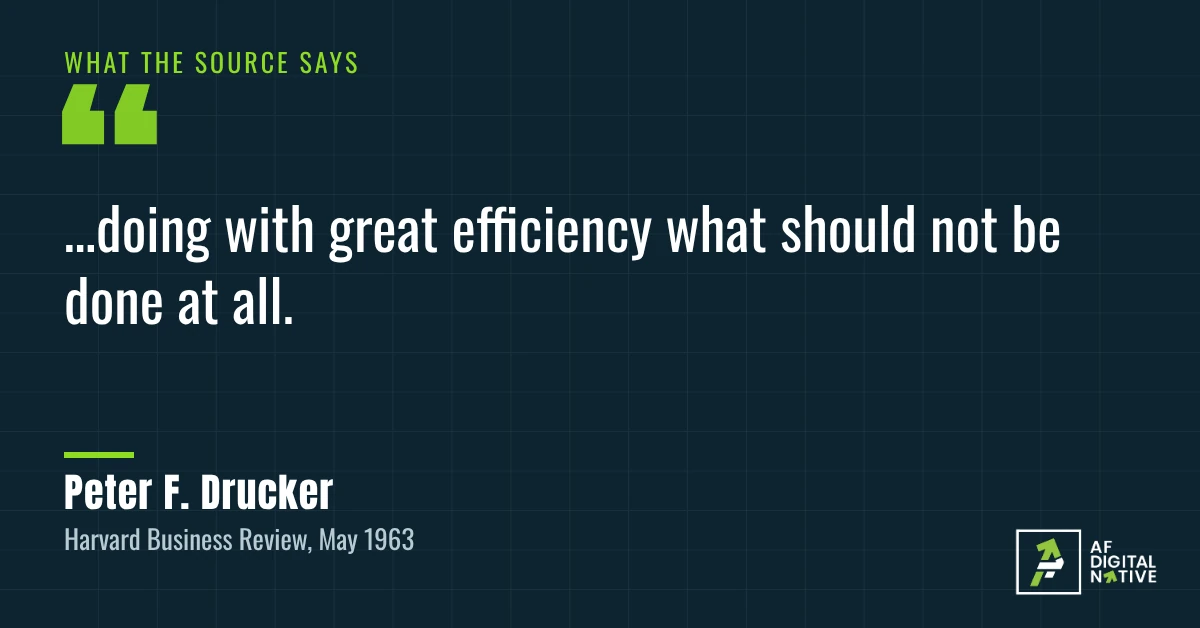
Put Drucker and Herbie side by side. Both say the same thing from different angles. Drucker warns you not to polish the wrong job. Goldratt shows you how to find the right one: look for the slowest spot, because it sets the pace for everything else.
Source: Eliyahu Goldratt, The Goal, 1984. The scout hike scene is described in LitCharts’ chapter 15 summary and in Supply & Demand Chain Executive. These are secondary sources, not the printed page.
Notice what the scouts did not do. They did not hold a meeting about hiking culture or buy better boots for everyone. They fixed one heavy pack. Small businesses can do the same thing, and most of the time the fix is just as plain.
So how do you spot that job? Use three rules.
I see this often with the organizations I work with. Here are two examples:
- Prepping a CSV by hand. Someone exports a list as a CSV, then works through a series of steps to clean and reshape the file so another tool or application will accept the import.
- Leaning on staff for the routine. Support and administrative staff handle bookings, rescheduling and appointment reminder follow-ups by hand.
Both jobs repeat, both move the same information from place to place by hand, and both cost you when a step gets missed. That is exactly the kind of job to look at first.
02Rule one, look for repeats
If a job only comes up once a quarter, I leave it alone. If it comes up every day, that is where I start. A system earns its keep by running over and over.
I would rather build a system for a dull job that runs every day than a clever one that runs twice a year. The dull job is where the hours go.
How to check:
- Count how many times the job ran last month. A rough count is fine.
- Under about five times a month is a weak candidate. That is my rule of thumb, not research.
Examples of jobs that repeat:
- Sending a receipt after each payment.
- Confirming a booking.
- Welcoming a new member.
- Drafting a first reply to a new lead.
03Rule two, count what a mistake costs
Some jobs are cheap to get wrong. A late newsletter is annoying. A missed invoice, a wrong access email or a lost lead costs money or trust. Those jobs are your best candidates, because a system can add a check.
Here is a question I like for this rule. When this job goes wrong, who finds out first, and when? If the answer is "the customer, a week later," the job needs a check before it needs anything else.
More examples of costly mistakes:
- A paid customer gets no access.
- A form lead sits unanswered over a weekend.
- An invoice goes out with the wrong amount.
04Rule three, count the retyping
Every time a person copies the same data from one place to another, a mistake can slip in.
The Lean Enterprise Institute has a word for this kind of thing. It defines muda, the Japanese word for waste, as "any activity that consumes resources without creating value for the customer." The Institute splits muda into two kinds. Some waste cannot be removed right away. Other waste can be removed quickly. Its example of the quick kind is moving products and inventory back and forth between steps. A kaizen workshop, it says, can remove those moves by arranging people and equipment into a smooth flow.
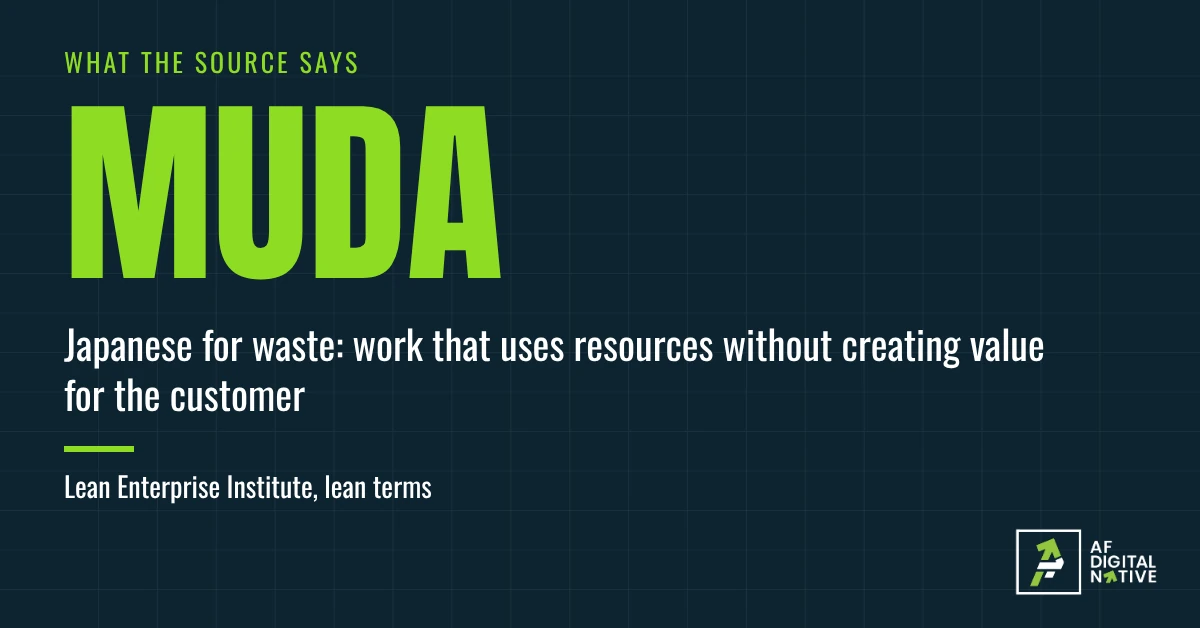
Retyping is the office version of carrying the same box from one table to another. The customer never sees it, and it adds nothing. It is also often the quickest waste to remove.
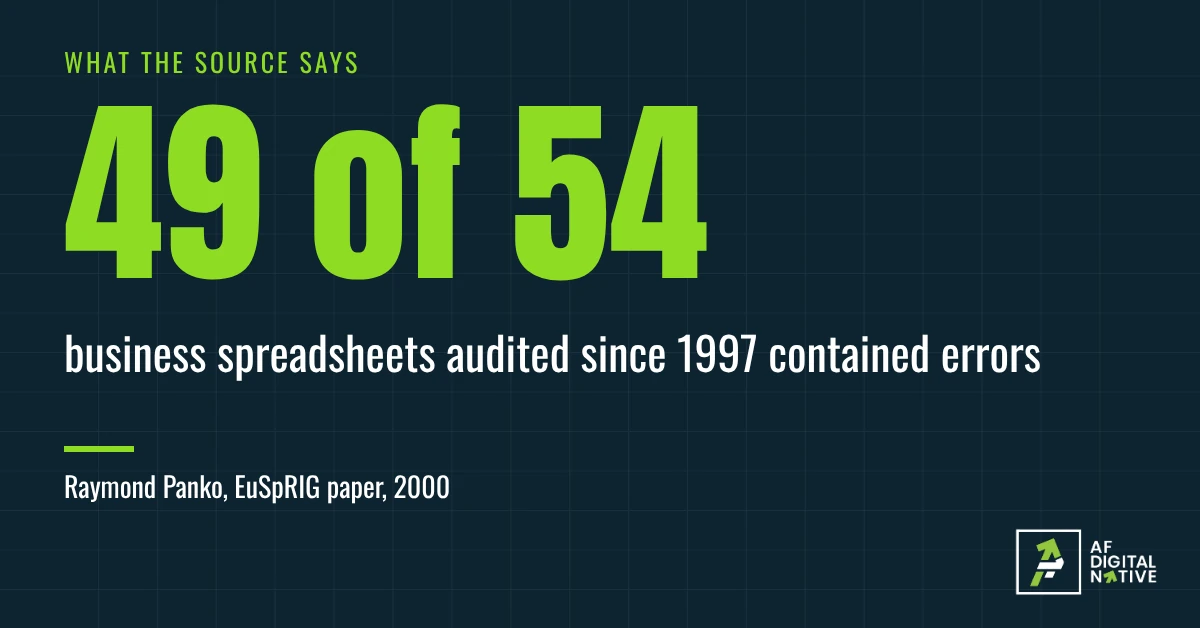
Spreadsheets are where retyped data often lands. Researcher Raymond Panko studied spreadsheet errors for years. He gathered field audits from 1997 onward. Two large audits looked at 23 and 22 business spreadsheets, and two smaller ones looked at 2 and 7. Across all 54, errors turned up in 91%, which is 49 of 54.
Be careful with that number, and so was Panko. The audits counted errors in different ways. One counted only spreadsheets that were off by at least 5%. Another counted only major errors. And these are spreadsheet errors in general, not retyping alone.
Panko also describes an experiment from 1999 that I find hard to forget. It was a lab study with students, not a field audit. People who built spreadsheets guessed their own chance of making an error at about 10% in the middle of the group. In fact, 86% had made one. When asked, well over half raised a hand to say they were among the lucky 14%.
I do not take that as a story about careless people. I take it as a story about confidence. We feel sure about work we built ourselves. That is one more reason to let a system do the second copy.
How to count:
- Write down every place the same data is typed in.
- Count the touches. Two or more is a signal.
Examples of retyping:
- A paid order copied into a spreadsheet, then into accounting software.
- A lead copied from an email into a contact list.
- A new member’s name typed into three tools.
05Score your list in 15 minutes
Here is the whole method in five steps. It is my own tool, not a published formula.
- List the jobs. Write every repeating job on one page. A job has a start and an end, like "send the welcome email." "Marketing" is not a job. Common mistake: listing departments instead of tasks.
- Score each job from 1 to 3 on repeats, cost of a mistake, and retyping. A 3 means a lot. Swap in your own words for "cost," such as hours, dollars or angry customers. Common mistake: scoring on how annoying a job feels instead of how often it happens.
- Add the scores and pick the top job. If two tie, pick the one that sits in front of your slowest step. That is your Herbie.
- Check the leave-alone list. Skip any job that rarely repeats, needs judgment or a relationship, changes every time, or is still being decided. If you cannot write its steps in five lines, it is not ready.
- Write one sentence of success. "This is done when ______." You will use it to test the system later.
Here is a made-up example so you can see the shape. The scores are illustrative.
Change a job name, tap 1 to 3 in each column, or add your own. A 3 means a lot. The top total is highlighted.
The first two tie. The access email wins here because a missed one costs trust right away. Your tie-break may differ.
The point of the table is not the totals. It is how the list changes shape once you score it. Jobs that felt equally annoying separate quickly, and the tax paperwork, which feels heavy, lands lower than you might expect.
Where scores can mislead
A score is a guide, not a verdict. A low-scoring job may still matter to you, and a high-scoring job may be easy to live with. Goldratt’s point also cuts the other way: the highest score is not always the slowest step. When in doubt, favor the job that holds up the rest of your work.
I also should not oversell the examples. They come from small organizations I know, and one case is not a trend. The Goldratt story is a novel, and I read it through secondary summaries.
Your five questions
Four clear answers and you have found your job.