
 By Angel Flores

On this page7 sections
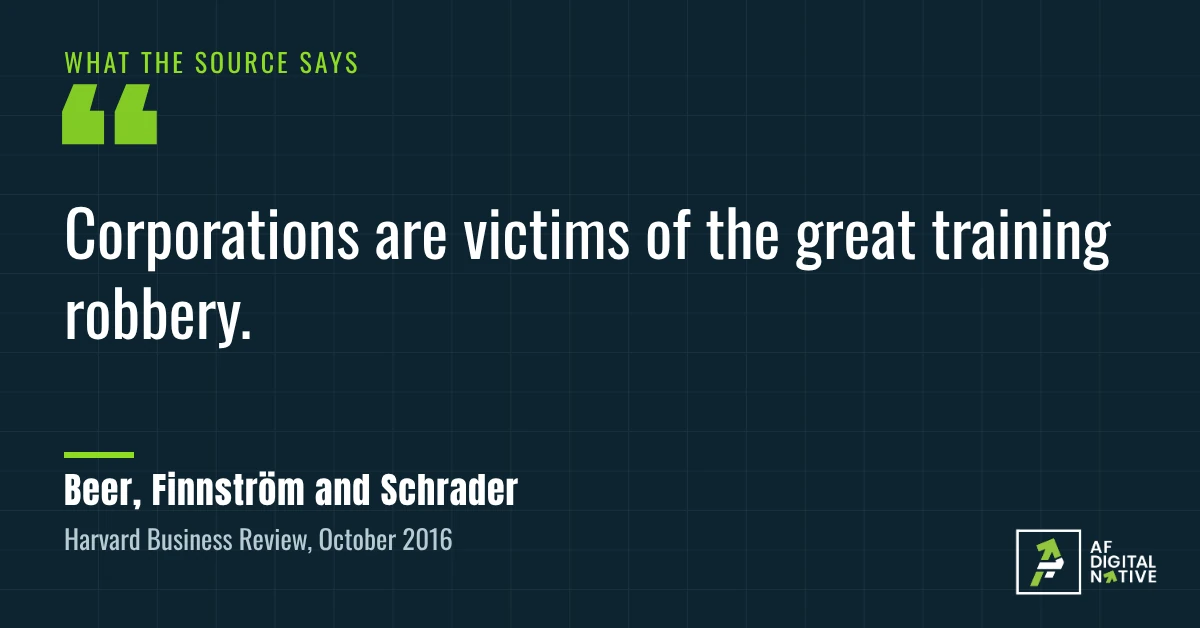
The authors of that article, Michael Beer, Magnus Finnström and Derek Schrader, then asked an uncomfortable question. What did all that money change?
Their answer was not kind. They wrote that corporations are victims of the great training robbery. People sit through the program, go back to their desks, and drift back to the old way of working.
I did not start this library to pick a fight with training. I started it because I keep meeting owners who are about to buy a course for a problem that a course cannot reach. Before you sign up for anything, ask what it is supposed to fix. Sometimes your people need a new skill. More often, the work needs a better setup.
I build systems for a living, so I lean toward implementation. I will tell you where I think training is the right call, too.
- Training teaches a person. Implementation sets up the work so it gets done.
- If your best person could fix the problem with a free afternoon, you have a setup problem, not a skill problem.
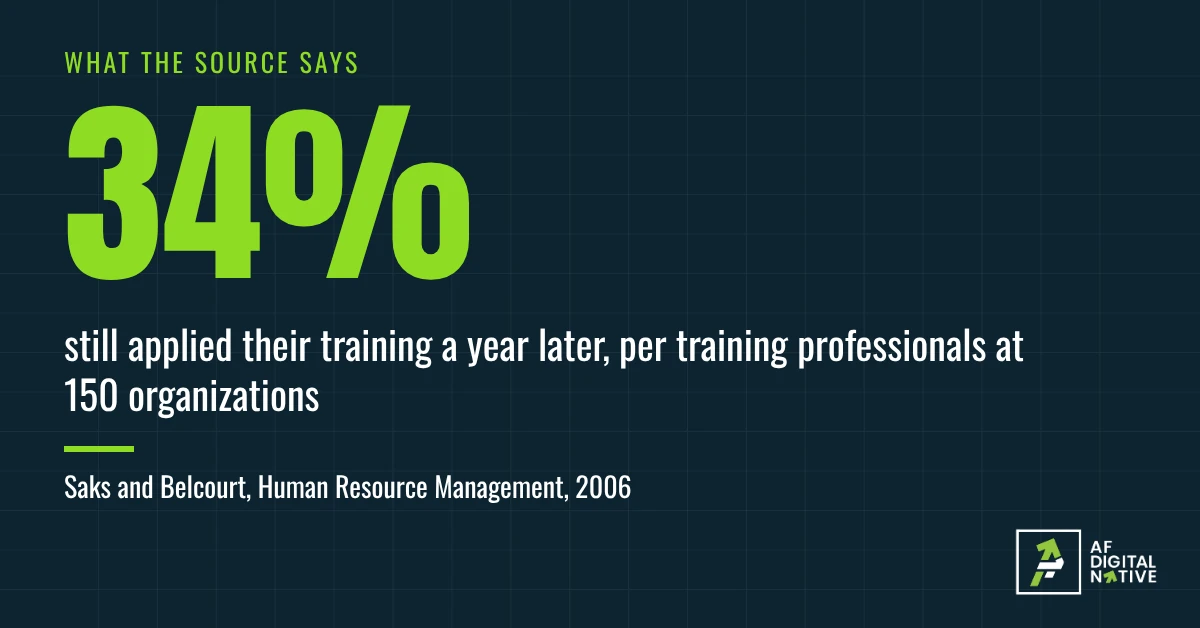
- Training on its own fades. In one study of 150 organizations, training professionals said about a third of employees still used their training a year later.
- Do both, in order. Set up one job, then train its owner on the real thing.
01Two different problems
Training teaches a person to do something. Implementation sets up the work so it gets done the same way every time, with or without that person. One fixes a skill gap. The other fixes a setup gap.
Two Stanford professors, Jeffrey Pfeffer and Robert Sutton, spent a book on this idea. The Knowing-Doing Gap came out in 2000. As one summary describes it, their argument is that organizations usually fail because they do not act on what they already know, not because they lack information. Closing the distance between knowing and doing, they say, matters more than closing the distance between ignorance and knowing.
Source: Jeffrey Pfeffer and Robert I. Sutton, The Knowing-Doing Gap, Harvard Business School Press, 2000. Their point is described in a summary hosted by the National Academies. A secondary source, not the book.
The same summary lists reasons the gap opens. Talk gets treated as if it were action. Habit and standard procedure take the place of thinking. People who fear punishment will not try a new method. Measures steer attention toward what is counted and away from the process underneath.
Read that list slowly. Notice that nothing on it says "the person lacked a skill." Every item describes the surroundings the person works in. That is the heart of this article, and it is why I think so many training budgets miss.
Many owners tell me they tried to learn AI on their own and stalled. They did the knowing part. They watched the videos, took the notes and tried the prompts. The job itself still runs the old way on Monday morning.
02Rule one, ask whose problem it is
Pick the job that is going wrong. Now picture your best person doing it with a free afternoon. Could they get it right?
- If yes, the problem is the setup. The steps are unclear, the data lives in three places, or nobody owns the job. That calls for implementation.
- If no, the problem is a skill. Nobody has learned how to do it. That calls for training.
Here is a made-up scene to show the test at work. A small office manager tells me her team "needs spreadsheet training," because every month someone spends an afternoon cleaning an exported list before it can go into another tool. I ask her to imagine the most capable person on the team getting a free afternoon. She says that person would finish, and then do the same thing next month. Nothing in that answer is about skill. The afternoon itself is the problem, and a course would teach people to do it a little faster.
I use that test because it moves the question from "who should learn something?" to "what is the job asking people to do?" The second question usually has a better answer.
Examples of setup problems:
- Someone exports a list as a CSV, then works through a series of steps to prep the file for another tool. A spreadsheet course will not remove those steps. A better setup will.
- Support and administrative staff handle bookings, rescheduling and appointment reminder follow-ups by hand.
- A new lead sits in an inbox because nobody is sure whose job it is to answer.
Examples of skill problems:
- Nobody on the team has ever written a proposal.
- A new hire has never used your accounting software.
03Rule two, see what training alone does
In 2006, Alan Saks and Monica Belcourt asked training professionals at 150 organizations a plain question: how many employees put their training to use on the job? The answers were 62% right after training, 44% after six months and 34% after a year.
Those are reports from training professionals, not measurements of the work itself, so read them as a rough guide. Even so, the shape of the curve is the story. Training does not usually fail on day one. It wears off, a little each month, until most of it is gone.
Now put the Harvard Business Review argument beside that curve. Beer, Finnström and Schrader do not stop at the spending. Their central claim is that the surroundings matter most. In their view, the structural and managerial problems around the people need to be fixed before, or alongside, any learning program, because a trained person goes back into the same organization.
The visible part of their article lists several barriers to change. They include unclear direction, leaders who do not work as a team, and weak coordination across the organization. Notice that these are not skill problems either.
A caution here. Their article is about leadership training inside large companies. I run into owners with a handful of employees. The scale is different, and the point still carries. A person trained on Friday walks back into Monday’s setup. If the setup has not changed, the old habits have the home field advantage.
I read all of this as a warning, not a ban. I am not telling you to cancel the course. I am telling you to ask what the person returns to once the course ends.
04Rule three, set up one job, then train the owner
Here is the order I use. It is my own method, not a published formula.
- Pick one job. Find the one job worth turning into a system shows how. Common mistake: starting with three jobs.
- Map it as it runs today. Map one process before you buy anything shows how. Common mistake: mapping how it should run.
- Fix the setup. Write the steps, pick the tool, add a check. Swap in your own tool if you already own one.
- Name the owner and a backup. Common mistake: leaving the owner as "everyone."
- Train the owner on the working system. Use the real job, not a demo. Common mistake: training the whole team before anything works.
- Review in a few weeks. Ask what broke and what people still do by hand.
Look at where training sits in that list. It is step five, after the job is chosen, mapped, fixed and owned. By then, the training has something real to point at. The person is not learning in the abstract. They are learning the thing they will run on Monday.
Examples of what the owner might be trained on:
- How to approve a draft before it goes out.
- How to read the weekly check and spot a miss.
- What to do the day it breaks.
Where training is the right call
I do not want to run training down. Some jobs need a skill that nobody on your team has, such as writing a proposal that wins work. Some work stays human by design, like judging a client’s mood or deciding what to approve. People who review AI drafts need to know what a good draft looks like. That is training, and it matters.
Also keep in mind that I sell implementation. Weigh my view with that in mind.
The evidence here has limits, too. The Saks and Belcourt numbers are self-reported by training professionals. The Harvard Business Review piece is an argument from three authors, and I could read only part of it. The Pfeffer and Sutton point comes to me through a summary. Together they point one way, but none of them is a test of your office.
Your five questions
If the first answer is yes, start with the setup.