 By Angel Flores
On this page7 sections
Do you need one? For most small businesses, not yet. A simpler tool usually does the job for less money and fewer surprises. The rest of this article shows you how to tell.
A machine from 1788 explains it best.
Steam engines of that era sped up and slowed down as their load changed. A mill needs steady power, so someone had to watch the engine and adjust the steam by hand.
James Watt added a small device to his engines to do that job. Two metal balls hung on arms and spun on a shaft the engine turned. The faster the engine ran, the higher the balls swung out. That pulled a lever that closed the steam valve a little. When the engine slowed, the balls dropped and the valve opened again.
If you own a thermostat, you know the idea. Too hot, turn the heat down. Too cold, turn it up. The device is called a centrifugal governor. As accounts of its history tell it, the idea came after a suggestion from Watt’s business partner, Matthew Boulton.
The governor had no judgment. It never decided anything. It followed one rule, the same way every time, and that was enough. Engine speed stayed steady, and nobody had to stand there and watch.
That is what an automation is: a rule you set once. An agent is something else. It works out the rule as it goes.
I start here because the word of the moment is "agent," and I keep meeting owners who are being sold one for a job that needs a governor. Deloitte’s 2026 Tech Trends report describes vendors rebranding existing automation as agents, a practice it calls "agent washing." Gartner has estimated that only about 130 of the thousands of vendors claiming agentic AI are real.
I build both kinds for a living, and I lean toward the simpler one.
- An AI agent is software that takes a goal, works out its own steps and uses tools to finish the job. An automation follows steps you wrote. The line is not AI versus no AI. It is who decides the steps.
- Most small businesses should start with an automation. Anthropic, the company behind Claude, advises finding the simplest solution possible and adding complexity only when needed.
- Agents cost more in time, money and mistakes. In Salesforce’s tests, top agents did well on routine workflow steps and much worse on longer, back-and-forth tasks.
- Sort the job with three questions. If you can write the steps down in advance, start with an automation.
01What an AI agent is, and what it is not
Anthropic published a guide to building agents in December 2024, written by its engineers. It draws one clean line. In what it calls workflows, the path is set in code ahead of time. In agents, the model directs its own process and decides which tools to use and how to get the task done.
Now translate that to an office. An automation is a recipe. Someone wrote down the steps, and the system follows them. An agent is a cook you hand the groceries to. You describe the meal and it decides the steps, which pan and what order.
Most people meet AI first through a chat window, so here is how it fits. When you type a question into ChatGPT and read the answer, that is a chatbot. It responds, and you do the rest. In July 2025, OpenAI added a separate agent mode to ChatGPT. According to TechTarget’s explainer, it combines the company’s earlier Operator and Deep Research tools and completes multi-step tasks using its own virtual computer. So the same product can be a chatbot one minute and an agent the next, depending on what you ask it to do.
Notice what the line does not say. An automation can contain an AI step. A recipe can say "ask the model to sort this email into one of four piles," and the path is still yours. That is what I meant in Everyone has tried AI. Few businesses run on it when I said AI is often one step of the job. The question is not whether AI is involved. It is whether the system is following your path or inventing its own.
Examples of automations, with or without AI:
- An invoice reminder goes out on day 30, and again on day 45, with no AI at all.
- A form submission creates a task, assigns an owner and sends a confirmation text.
- A new email comes in, AI labels it as billing, scheduling or a sales lead, and the system routes it to the right person. The path is fixed, and one step uses AI.
Examples of agents:
- You ask a system to research a prospect, decide what matters and write the first note, and it chooses which pages to read and what to do next.
- You hand a messy support thread to a system that decides whether to look up an order, ask the customer a question or escalate.
02What an agent costs
Anthropic’s guide is blunt about the tradeoff. Agentic systems often exchange speed and cost for better performance on a task, and the authors say to weigh whether that is worth it. Because an agent acts on its own over many steps, it can also compound errors, so they recommend extensive testing in a sandbox with guardrails. Their advice on where to start is to find the simplest solution possible, and some applications do not need an agent at all.
Take that with one grain of salt. Anthropic sells agent tooling, and it is telling you to start smaller. I find that more convincing, not less, but you should know who is talking.
Salesforce AI Research tested leading AI agents on a benchmark of customer relationship tasks, using synthetic company data. The agents succeeded about 58% of the time on single-turn tasks. On multi-turn tasks, where the agent had to ask follow-up questions and gather information, success dropped to about 35%. The same paper reports that the strongest agents passed 83% on workflow execution in single-turn tasks. Carnegie Mellon researchers built a simulated software company and ran 175 workplace tasks. The best agent they tested completed about 30% of them on its own.
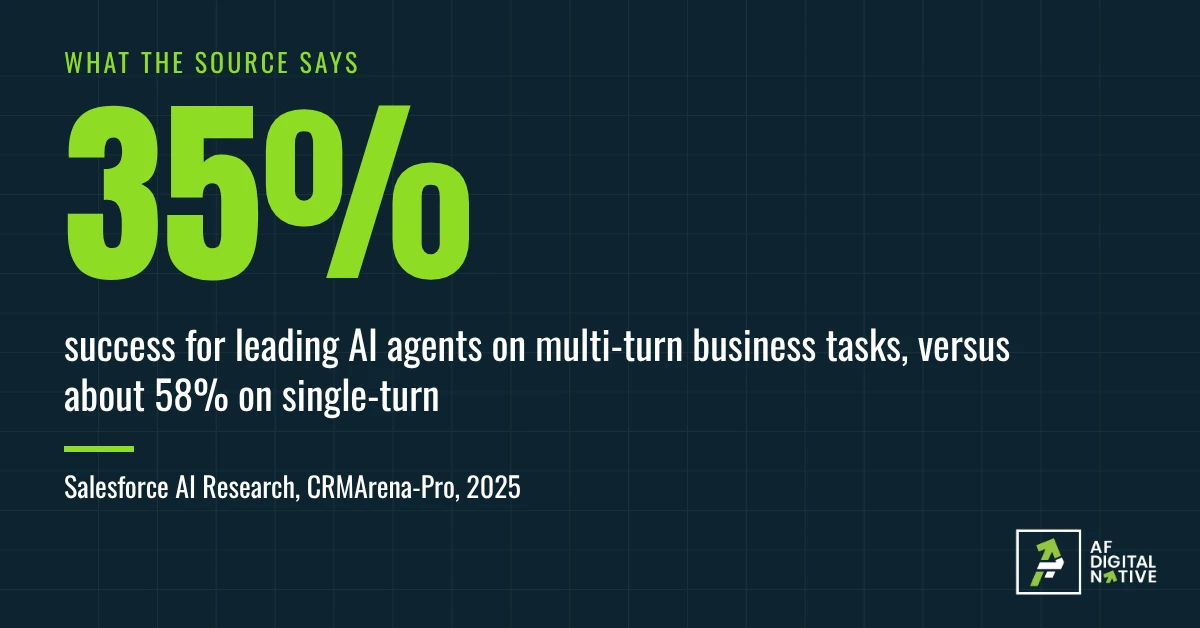
I read those numbers as a shape, not a verdict. Models improve quickly, and both tests used models from 2025. The shape is what matters. Routine, well-defined steps went well. Open-ended work with many turns went much worse. That is exactly where a small office has the least slack to absorb a wrong answer.
The business side points the same direction. Deloitte says a lot of projects labeled agentic are really automation in disguise, and that enterprises often choose agents when a simpler tool would do, with poor returns. In the same chapter, it reports that 14% of surveyed organizations had agentic solutions ready to deploy and 11% were actively using them. Gartner went further in 2025 and predicted that more than 40% of agentic AI projects will be canceled by the end of 2027, citing rising costs, unclear business value or inadequate risk controls. A prediction is not a fact. It is an informed guess from an analyst firm.
03Do you need one? Three questions
Gartner’s Anushree Verma drew the same line from the analyst side. Agents are for work that needs decisions, assistants are for simple lookups, and for routine workflows she recommends "automation," as she put it.
Here is how I turn that into three questions for a small office. This is my own method, not a published formula.
- Can I write the steps down before it starts? If yes, it is a routine workflow.
- Is the right answer the same, or one of a short list, every time? If yes, a rule can handle it.
- What does a wrong answer cost, and would anyone catch it? If the cost is high and nobody checks, keep a person in the loop.
Here is a made-up scene to show it at work. A small HVAC company gets service requests by phone, web form and text. The owner is tempted to buy an agent that "handles scheduling." I ask her to write down what happens today. A request comes in. Someone creates the job record, decides if it is urgent, finds a technician with an open slot, and confirms with the customer.
Most of that is a path she can draw. Creating the record and sending the confirmation need no judgment, so those are plain automation. Sorting urgent from routine is a short list, so one AI step can do it, with a person glancing at anything marked urgent. The only part that changes case by case is fitting a job around technicians’ routes and parts, and even there, a dispatcher can approve a suggestion in a few seconds. In my view, that one piece is the only place an agent might earn its keep, and she can try it after the rest is working.
04Earn the complexity
Anthropic says to add complexity only when it demonstrably improves outcomes. I agree, and here is the order I use. It is my own method.
- Write the steps as they run today. Map one process before you buy anything shows how. Common mistake: describing how you wish it ran.
- Build the plain automation first. Triggers, rules, a check, a log. Common mistake: skipping to the exciting part.
- Add one AI step where a rule cannot decide. Sorting, summarizing or drafting, with a person checking. Common mistake: asking AI to run the whole job.
- Watch for the cases that keep breaking the path. Keep a short list for a few weeks. Common mistake: judging by the one case that went wrong.
- Try an agent on that one piece, with a person approving. Compare cost, time and misses against the automation. Keep it only if it wins. Common mistake: letting it act without approval on day one.
Notice the shape of that list. The agent arrives at step five, if it arrives at all, and it arrives with evidence that the simpler version is not enough. It also arrives late for a practical reason. An agent needs connected systems and live data to act on, the same foundation an automation needs, and I wrote about why that foundation matters in Everyone has tried AI. Few businesses run on it.
Where an agent is the right call
I do not want to run agents down. Some work really does change shape every time, such as researching an unfamiliar topic, untangling a messy thread of requests, or planning around many constraints. If a wrong answer is cheap, or a person approves before anything goes out, an agent can save real time. If the steps are different every time and you cannot write them down, a fixed path will not hold.
Also keep in mind that I sell implementation, and most of what I build is the simpler kind. Weigh my view with that in mind.
The evidence has limits, too. Anthropic’s guide comes from a company that sells agent tools, and it dates from December 2024. The Salesforce and Carnegie Mellon results come from synthetic or simulated settings and from models of 2025. The Deloitte figures describe large organizations, and Gartner’s number is a forecast. The Watt story reaches me through histories of control engineering, not his own papers. "Agent" also has no fixed definition, and vendors use it loosely. All of it points the same way, and none of it is a test of your business.
Your five questions
If the first answer is yes, start with an automation.