 By Angel Flores
On this page7 sections
One half also received case studies showing how AI-native companies had rebuilt their work around the technology, their workflows, their teams and their business models. The other half attended workshops on general entrepreneurship. That was the only difference.
This is a field experiment by Hyunjin Kim, Dahyeon Kim and Rembrand Koning, published as an INSEAD working paper in March 2026. The firms that saw how others had reorganized went looking in more places. They found 44% more uses for AI, mostly in product development and strategy, and the authors report meaningful gains in performance.
I read that result as the whole story of small business AI in one experiment. The tool was never the scarce thing. Every firm had the tool. The scarce thing was seeing where it fits in the work.
That is the difference between using AI and running on it. Using AI is opening a tool when you remember to. Running on AI is a job set up so the tool does its part the same way every time, with or without you.
- Using AI is opening a tool. Running on it means a job is set up so AI does one step of it, every time.
- In a field experiment on 515 startups, the firms shown how others reorganized work around AI found 44% more uses than firms with the same tools and training.
- Surveys say anywhere from nearly 18% to 76% of small businesses use AI, depending on the question. In one survey, only 14% said it is fully embedded in their core operations.
- AI needs connected systems, live data and digital workflows to plug into. Without them, a new AI tool is one more subscription in a fragmented stack.
- To close the gap, move one job: give it a trigger, one AI step, a check and an owner.
01Two numbers from one survey
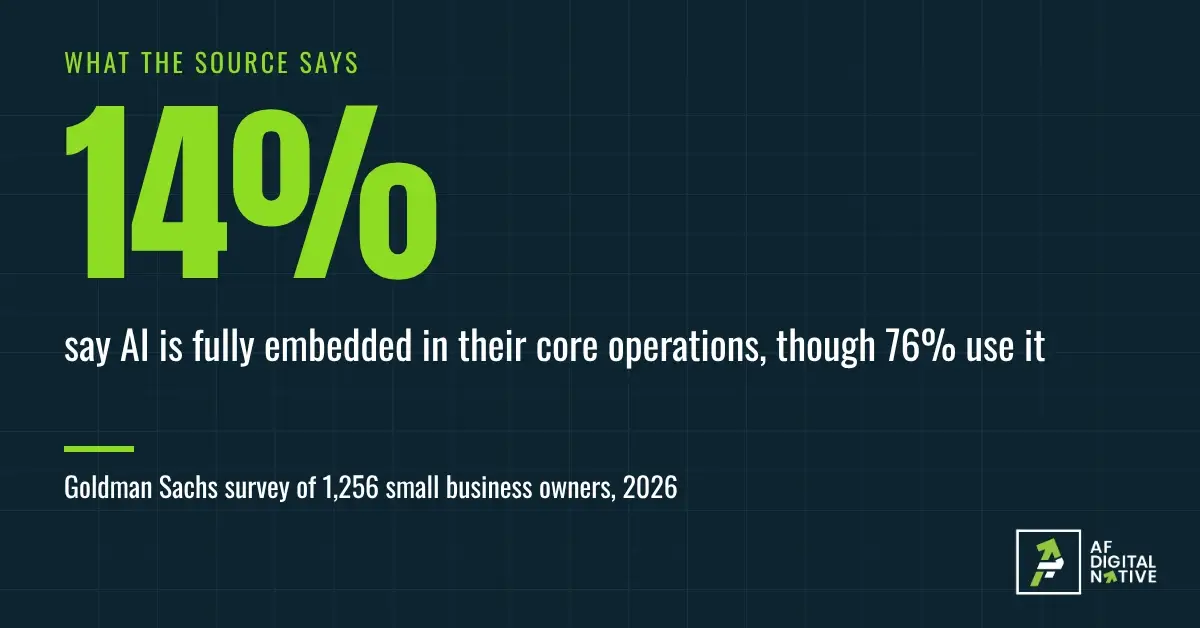
In early 2026, Goldman Sachs asked 1,256 small business owners about AI. The survey, run with Babson College and David Binder Research from January 27 to February 4, found that 76% were using it, and 93% of those users reported a positive impact.
Then came the second number. Only 14% said they were fully integrating AI into their core operations.
Other counts disagree, and the disagreement is useful. The Federal Reserve Banks’ Small Business Credit Survey found that 46% of employer firms said their business or its employees currently use AI. Another 15% planned to start within a year. The JPMorganChase Institute took a different route and looked at payments. It counted small businesses paying for AI services, and found adoption rising from about 5% in late 2022 to nearly 18% by the end of 2025.
So is it 18%, 46% or 76%? I do not think any of them is wrong. Each one asks a different question. The Fed asks whether anyone at the business uses AI. JPMorgan counts only paid tools. Goldman asks members of its own small business program, who tend to be engaged owners.
None of the three measures what I care about, which is whether a job in your business runs on AI. The closest is the 14%, and it is a self-report, so treat it as a rough guide. Even so, the gap between the first number and the second is the pattern I keep seeing. Most owners have tried AI. Few have built a job around it.
02What electricity taught factories
None of this is new. Every general-purpose technology has gone through the same gap.
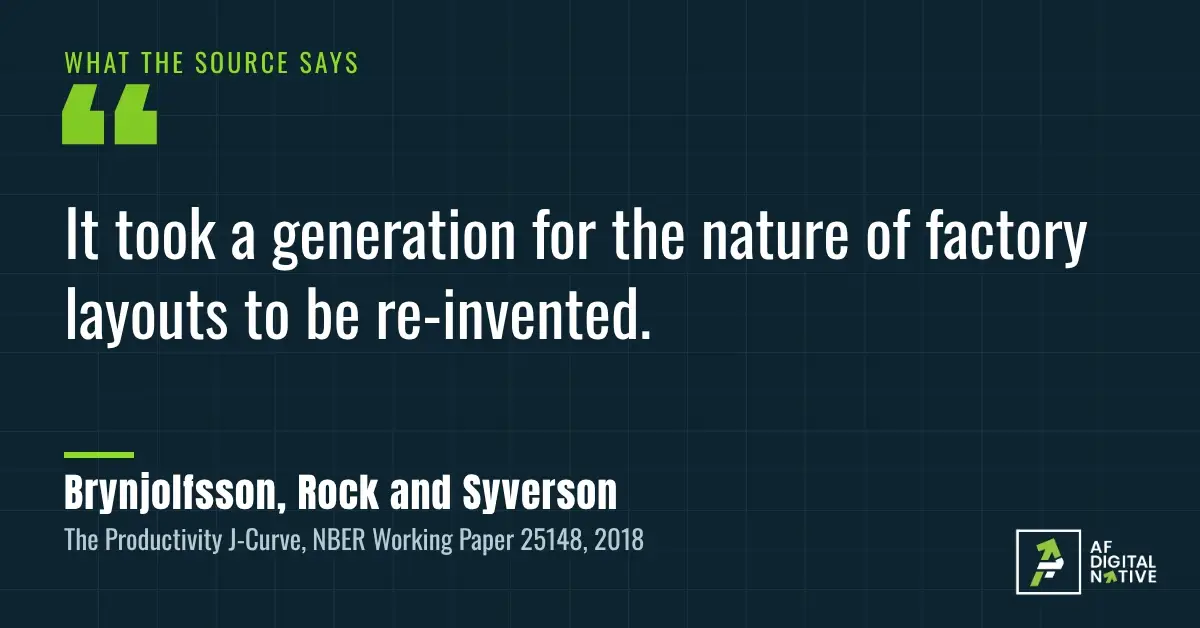
Economists Erik Brynjolfsson, Daniel Rock and Chad Syverson wrote a paper on it, "The Productivity J-Curve." Their argument is that technologies like AI come with a requirement. They need significant complementary investments, including redesigned business processes, and those investments are mostly intangible and hard to see in the numbers. Firms must create new processes, build managerial experience, train people and patch software before the benefit shows up.
Their history lesson comes from electricity. In their words, it took a generation for the nature of factory layouts to be re-invented.
Another set of economists, Ajay Agrawal, Joshua Gans and Avi Goldfarb, tell the same story in Power and Prediction. As one summary of their book describes it, early factories were built around a single point of power, with hundreds of moving parts tied to it. A new kind of power did not change that. The real gains came when entrepreneurs rethought the factory itself. The authors separate point solutions, which improve one task inside the old system, from system solutions, which rebuild the system around the new capability.
Notice what that means for a ten-person office. Pasting AI into your old way of working is a point solution. It is real, and it helps. It is also the factory with a new motor in the same old layout.
You can see the same pattern without any AI at all.
- A shared calendar that people check when they remember, versus a booking flow where the calendar starts the job.
- A CRM that holds contacts, versus a CRM where a new lead creates a task with an owner.
- Accounting software used for looking things up, versus a monthly close that runs from it on a set day.
That is where the factory story meets your office. The new layout a business has to build is a digital one. AI only works inside a digitally native organization, where the work already lives in connected systems, live data and digital workflows. Those are the things AI plugs into. Without them, you are not adopting AI. You are adding another subscription to an already fragmented stack.
Here is what each of those three looks like in a small office.
- Connected systems: the web form, the CRM and the calendar pass information to each other, so a new lead does not have to be retyped by a person.
- Live data: the numbers the AI reads are today’s numbers, in one place, not last month’s export sitting in someone’s inbox.
- Digital workflows: the job moves from step to step inside a system, with a trigger and an owner, instead of living in someone’s head or on a sticky note.
Now picture the opposite. Leads arrive in three inboxes, the schedule lives on a whiteboard, and invoices travel as spreadsheets by email. Add an AI writing tool to that office and it can draft a beautiful follow-up, but it cannot see which lead is new, which job is booked or which invoice is overdue. It has nothing to plug into. That is why I say the foundation comes first.
03What running on it looks like
Here is a made-up scene to show the difference. A small remodeling company has an owner who uses AI to polish estimate follow-ups. When she remembers, she pastes her notes into a chat window, tweaks the draft, and sends it. It works, and she likes it. It also depends entirely on her memory, her mood and her calendar. On a busy week, nothing goes out.
That is using AI. Now picture the same job running on a system.
- Sending an estimate starts the job. Nobody has to remember.
- AI drafts the follow-up from the estimate and the job notes.
- The office manager checks the draft before it goes out.
- The email sends, and the date is logged.
- If there is no reply in three days, the job creates a reminder to call.
- One person owns it, and has a named backup.
Count the steps. AI does one of them. The other five are plain setup: a trigger, a check, a log, a nudge and an owner. In my experience, that proportion is typical. AI is rarely the biggest part of the system. It is the part that gets the attention.
You can tell which side of the line a job sits on with three questions.
- If you were out for a week, would it still happen?
- Does something start it, other than your memory?
- Is there a check before it reaches a customer, and a named owner?
Three yeses mean the job runs on a system. Anything less, and you are still using a tool.
04Why the gap stays open, and how to close it
The INSEAD authors have a name for the barrier. They call it the "mapping problem," meaning the difficulty of discovering where and how AI creates value within a firm’s production process. Two firms with the same tools, the same training and the same budget can get very different returns, they argue, if only one of them searches widely across its work for where the technology belongs.
That fits what the Fed found when it asked small firms already using AI about their challenges. The top two were accuracy, at 46%, and adapting tools to meet business needs, at 43%. Neither one is about access. Both are about fit. Does the output hold up, and does the tool slot into how the job actually runs?
I would add one more reason, from the owners I meet. Casual use works well enough that nobody feels forced to build anything. The pain is quiet. Nothing breaks, and the work is a little slower and a little less consistent than it could be.
Here is the order I use to move one job from using to running. It is my own method, not a published formula.
- Pick the one use that already works for you. Find the one job worth turning into a system shows how. Common mistake: starting with the flashiest use.
- Write what starts it and what finishes it. One sentence each. Common mistake: skipping the finish line.
- Put AI in one step. Write what you hand it and what you expect back. Common mistake: asking AI to run the whole job.
- Add a check before it reaches a customer. One person, one look. Common mistake: trusting a draft because it reads well.
- Name the owner and a backup, then run it for a few weeks. Mark what you still do by hand and what broke. Common mistake: leaving the owner as "everyone."
If you are not sure where the job really starts and ends, map one process before you buy anything first. The INSEAD firms were given examples to help them see their own work. A map does that job for you.
Where using is the right call
I do not want to turn every use of AI into a project. Plenty of uses should stay casual, such as brainstorming, a rough first draft you will rewrite anyway, or a question you ask twice a year. Building a system for those would cost more than it saves. Reserve the setup work for jobs that repeat, touch customers or money, or break when one person is away.
Also keep in mind that I sell implementation, so weigh my view with that in mind.
The evidence has limits, too. The Goldman survey covers members of Goldman’s own program, and "fully embedded" is the owner’s own description. The Fed survey is a weighted convenience sample. The JPMorgan figure counts paid tools only, so by design it leaves out free ones. The INSEAD study is a working paper, not yet peer reviewed, and its firms were high-growth startups running a short program, not a plumbing company with six employees. I left out its revenue result because I could not confirm how to read it. The factory story reaches me through an economics paper and a book summary. All of it points the same way, and none of it is a test of your business.
Your five questions
If the last answer is no, start there.