
 By Angel Flores

On this page9 sections
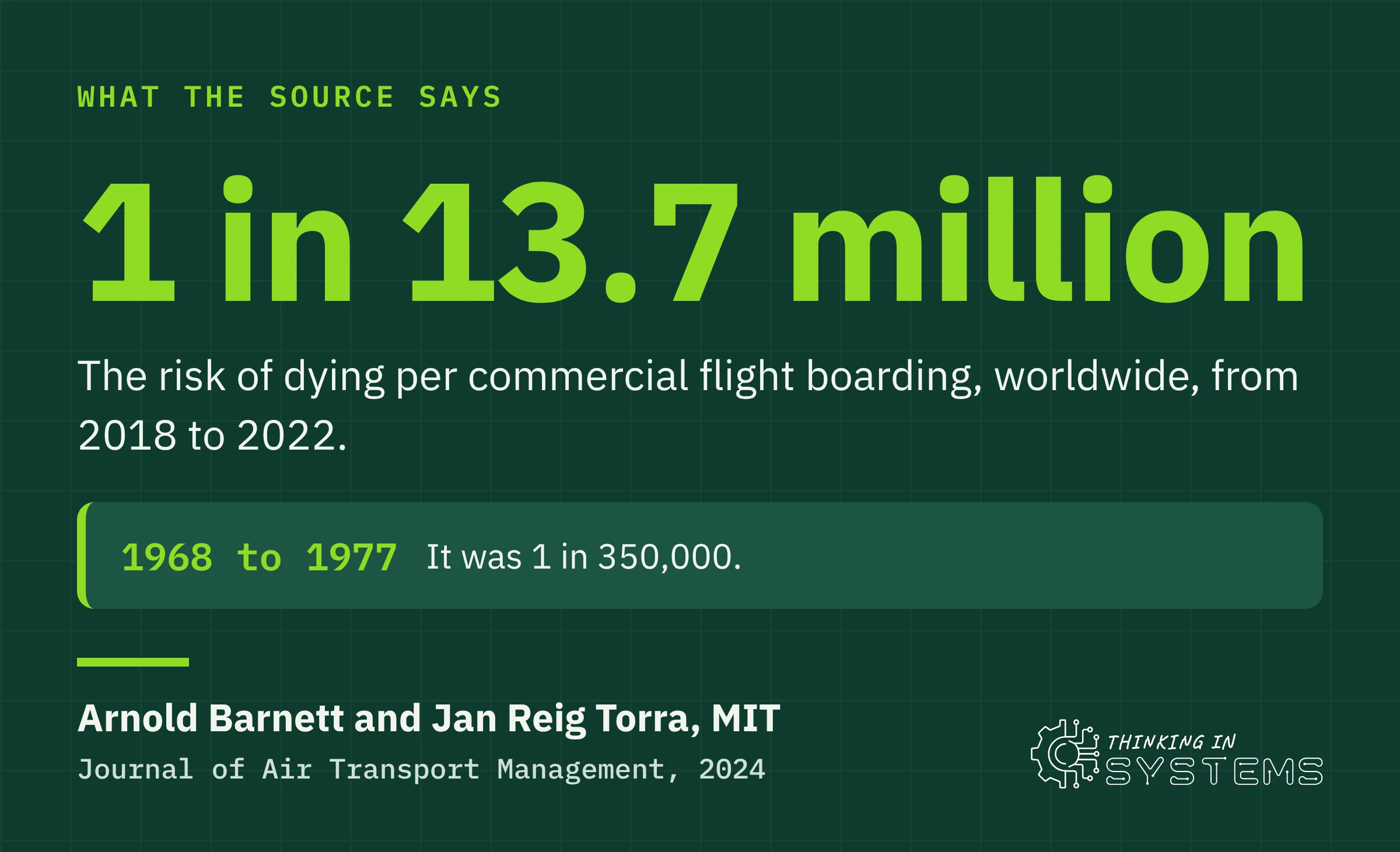
If you boarded a commercial flight between 1968 and 1977, your chance of dying on that trip was about one in 350,000.
Between 2018 and 2022, it was about one in 13.7 million.
Those numbers come from Arnold Barnett at MIT, who has studied airline safety for years. His 2024 paper found that flying has gotten roughly twice as safe in every decade since the late 1960s.
Barnett points to a few reasons. Better technology in the planes. More training for the people who fly them. And the steady work of investigators like the National Transportation Safety Board, the NTSB. This series is about that last one.
This is a series about how organizations really run. In every episode, I open a case file on a real organization, find out what really went wrong or right, and leave you with one or two big ideas you can use in your own. This first episode shows you how that works.
Why we study what broke
What those investigators built is a habit. When something goes wrong in aviation, someone looks at the whole system, not just the pilot. They look at the aircraft, the procedures, the training, and the way the crew talked to each other. They write down what they found, share it across the industry, and change how the work runs.
In my experience, most organizations do the opposite. When something breaks, they find the person standing closest to it, fix that person and move on. A few months later, the same thing breaks again, with someone else standing nearby.
So let’s watch that habit at work in one real investigation, and see what it can teach an organization that has nothing to do with airplanes.
The case file: Flight 173
On the evening of December 28, 1978, United Airlines Flight 173 was coming in to land at Portland, Oregon. It was a DC-8 on the last leg of a trip from New York, by way of Denver, with almost two hundred people aboard.
When the crew lowered the landing gear, something went wrong. A corroded part in the right main gear had come apart, and that side of the gear fell free instead of coming down normally. There was an unusual noise and vibration, and the crew couldn’t confirm the gear was down and locked.
So they did something reasonable. At about 5:12 in the evening, the captain told air traffic control they’d hold at five thousand feet, southeast of the airport, while they worked the problem. They had about 13,300 pounds of fuel. According to the Federal Aviation Administration’s review of the accident, the gauges in front of them would have shown roughly an hour of flying left.
For the next hour, the crew worked the gear problem. They went through the procedures, and they prepared the cabin for a possible emergency landing.
The fuel did come up. About 38 minutes into the hold, the captain figured they’d need about another fifteen minutes. The flight engineer’s answer is in the NTSB’s report: "Fifteen minutes is gonna run us low on fuel here."
The board also found that the first officer had made several subtle comments about the fuel. None of it changed the plan.
A little after six, the engines began to flame out, one after another. At about a quarter past six, the plane came down in a wooded neighborhood about six miles from the airport. Ten people died: eight passengers, the flight engineer and a flight attendant. Twenty-three more were seriously injured. No one on the ground was hurt.
That loss is why what came next matters, so I want to slow down here.
The investigators found that the captain had been preoccupied with the landing gear and the emergency preparations, and hadn’t properly watched the fuel. They also found that the other two crew members either didn’t fully grasp how critical the fuel was, or didn’t get their concern across to him.
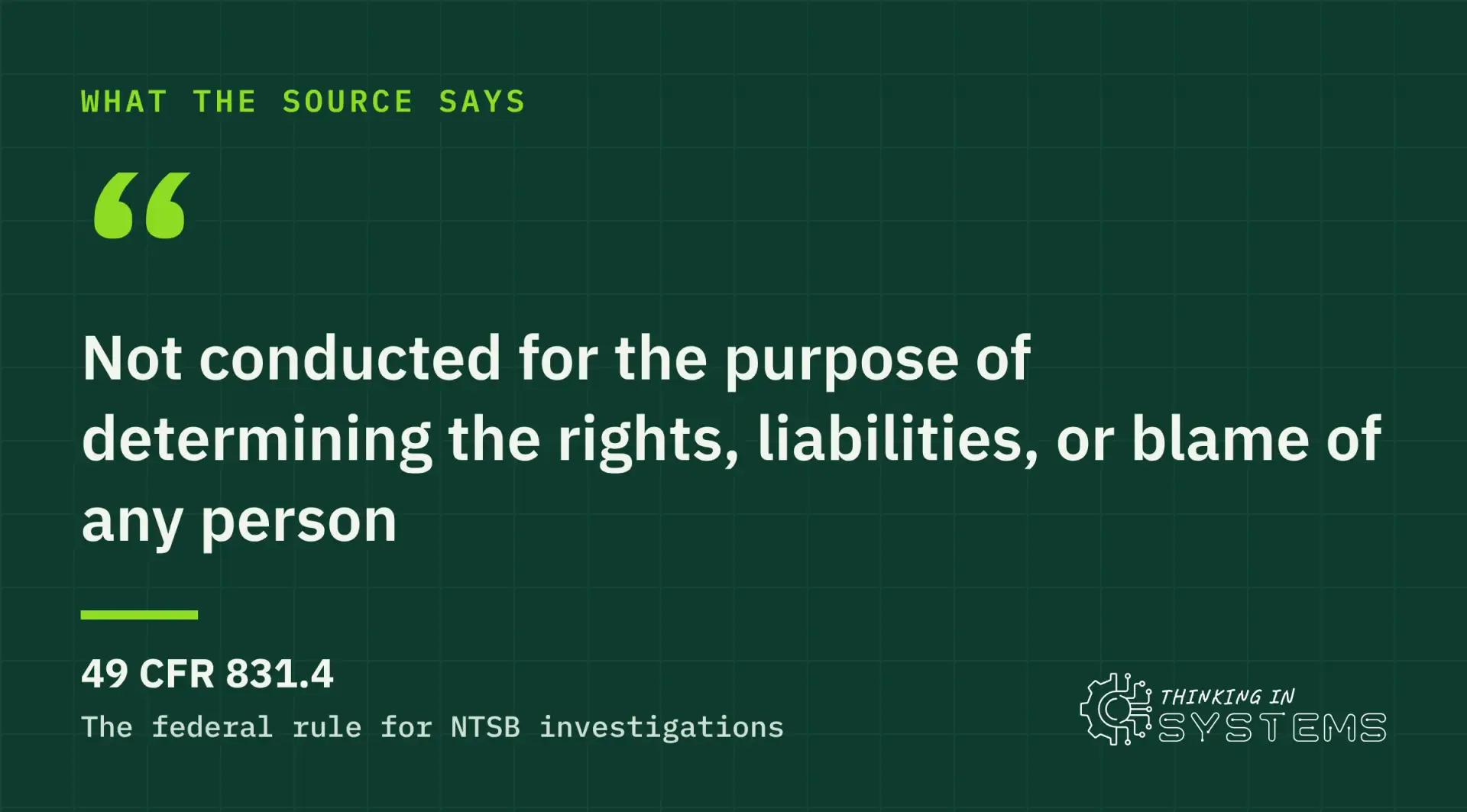
Now here’s what they did with that finding. The NTSB doesn’t run its investigations to blame anyone. That’s written into federal regulation. Its investigations are "not conducted for the purpose of determining the rights, liabilities, or blame" of any person.
So instead of stopping at the captain, the board looked at how the crew worked together. It recommended training in how captains manage the cockpit, with an emphasis on inviting input from the crew, plus training for the other crew members. In its analysis, the board said that training crews to speak up should be part of the standard curriculum.
Six months later, in June 1979, NASA held a workshop in San Francisco on resource management on the flight deck. According to NASA, the research presented there found that junior crew members regularly hesitated to correct their captains. That wasn’t one crew’s problem. It was built into how cockpits worked.
Out of that work came crew resource management, a way of training crews to share what they see, say it clearly and decide together. United launched its program in 1981, other airlines followed, and it later became a regulatory requirement.
What really went wrong
So what actually went wrong over Portland? Not the landing gear. A gear problem is the kind of thing crews train for. What went wrong is that the answer was in the cockpit the whole time, and it never reached the decision.
Think about where the information was. The gauges showed it. The flight engineer knew it, and he said so. The first officer hinted at it more than once. And according to the FAA’s review, nobody ever put the fuel that was left side by side with the time it would take to land. Everything needed to save that flight was within a few feet of the captain.
But for most of that hour, the crew’s job had quietly shrunk to one thing, the gear. And the way the cockpit worked turned every warning into a remark. A junior crew member could mention the fuel. Nobody expected him to stop the plan. On paper, the captain owned everything, and when one person owns everything, nobody owns the fuel clock.
So here’s the first big idea from this episode, and you’ll hear it come back again and again in this series. Information that never reaches the person deciding might as well not exist.
Your organization has its own fuel gauges. A report that shows the problem weeks early. A support agent who keeps hearing the same complaint. A junior analyst who noticed the numbers didn’t add up. The information is there. It just doesn’t travel the last few feet.
Now notice what’s missing from this story: a bad pilot. The investigators didn’t stop at the captain, and that’s the second big idea. When a person fails, look for the system that let it happen. It doesn’t excuse anyone. It just keeps asking until it finds the part you can actually change.
The contrast case: Flight 1549
Now jump ahead thirty years, to a crew that had the training.
On January 15, 2009, US Airways Flight 1549 took off from LaGuardia in New York. Less than two minutes later, it flew into a flock of Canada geese, and both engines lost nearly all their thrust.
According to the FAA’s review, the captain started the auxiliary power unit, said "my aircraft," and took over flying. He told the first officer to get out the checklist for losing both engines, and the first officer worked through it while the captain flew. That checklist was written for a failure at high altitude, and there wasn’t time to finish it. About three and a half minutes after the birds hit, the plane touched down on the Hudson River. All 155 people aboard survived.
The NTSB credited the crew’s decision-making and their crew resource management with helping them keep control of the airplane, which made the landing more survivable. The FAA’s review adds that the two pilots had met only three days earlier. According to NASA, the captain, Chesley Sullenberger, was trained in crew resource management, and key parts of it had been required at US Airways since 1995.
Notice the difference. Each person had a job. The information traveled. And there was no doubt about who was flying the airplane.
I want to be careful here. Flying got safer for many reasons, and no single change gets the credit. But this is one of the clearest examples I know of a fix aimed at the system instead of the person, and of what it looks like when it works.
What to do differently
So what did aviation actually change? Three things, and each one has a version in your organization.
The first is the question it asks. Aviation decided to ask how the system let it happen, not only who failed. The no-blame rule is part of that, and I think it’s a big part of why the approach works. When people know an investigation isn’t hunting for someone to punish, they’re more likely to tell the whole truth. In your organization, that’s the difference between a review that asks "who dropped this?" and one that asks "what let this drop?"
The second is where the fix lives. It wasn’t a memo telling pilots to watch the fuel. It was training, for crews as a team, on how to speak up and how to listen. A captain who invites a challenge, and a crew that knows how to give one. A memo asks people to try harder. A change in how the work runs doesn’t depend on anyone remembering.
The third is that the habit never stops. Every accident gets investigated, even the ones that end well. The NTSB spent fifteen months on Flight 1549. It found that the checklist the crew reached for was built for a failure at high altitude, not one just after takeoff, so it recommended a new checklist for losing both engines at low altitude. The success got studied too, and what it taught went back into the system.
What this series is
That’s the idea behind Thinking In Systems. Most organizations do not lack effort. They lack a way to think about systems, build them to fit, and keep them running.
So every episode follows the same path. A case file on a real organization, sometimes a failure and sometimes a success worth copying. What really went wrong, or right. A contrast case when there’s a good one. One or two big ideas you can take to work. And then your own organization.
I have one rule for how we do this, and I borrowed it from the NTSB. Hindsight makes every failure look obvious. We look at the system before we blame anyone. Most of the people in these stories were smart and careful, which is exactly why their stories are worth studying.
You’ll hear about systems of every kind: buying new software, mapping how work really moves, the slowest step in a process, training, workflows, automation, and who owns a system when it breaks. Some of it touches AI, and most of it doesn’t.
If you want hands-on marketing operations, my series Behind the Campaign is built for that. If you want to put AI to work, that’s Attainable AI. This series is the one that steps back and looks at how all of it fits together.
Bring it home
Before you go, try this on one of your own systems.
Pick one your organization relies on. It could be the month-end close, onboarding a new customer, or getting a contract renewed before it lapses. Then ask three things.
First, is there a fuel gauge in that system that everyone can see and nobody is reading? It might be a report that goes out every week and nobody opens, or a number on a dashboard that’s been drifting for months.
Second, if someone on your team spotted a problem in it, how far would that information have to travel to reach the person who decides, and where could it stop along the way?
And third, who on your team would hesitate to tell you something’s wrong? That one’s uncomfortable. It’s also where the most expensive surprises hide.
Two things to take with you
If you take two things from this episode, make it these.
The first is that information that never reaches the person deciding might as well not exist. Find your fuel gauges, and make sure someone’s reading them.
The second is that when a person fails, you look for the system that let it happen. That’s usually where the lasting fix is.
And that’s why we study these cases at all. Organizations that already paid for the lesson are the cheapest teachers you’ll ever have.
If you’d like a second set of eyes on one of your own systems, start with the system map builder on my website, or book a free 30-minute systems call. And keep listening, or reading. There are a lot more cases to open.
Next time, in episode two, we’ll look at what happens when a company switches on a big new system at the worst possible moment. Hershey’s new order system went live just as Halloween orders were pouring in. That’s A Tool Is Not a System.