 By Angel Flores
On this page7 sections
Each unit also got a cart with the supplies in one place. Nobody had to remember all of it alone, and a clinician who skipped a step could be stopped.
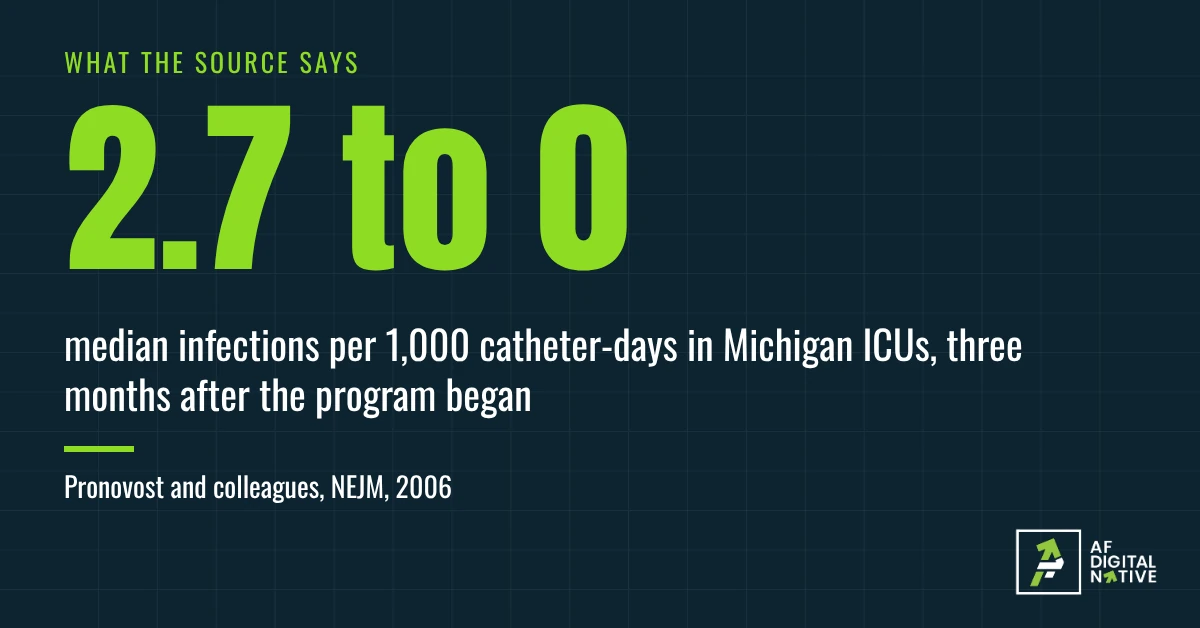
Peter Pronovost of Johns Hopkins and his colleagues reported what happened in the New England Journal of Medicine in 2006. Across more than 100 ICUs, the typical rate of bloodstream infections linked to those lines fell from 2.7 per 1,000 catheter-days to zero within three months. The drop held for 18 months.
Look at what that program was not. It was not a new machine, and it was not one brilliant person. The steps themselves were already known. What changed was that the work ran the same way each time, in the same order, with the supplies in reach and a way to catch a missed step.
That is a workflow. And it is the thing I most want you to see in this article.
You do not run an ICU. But you have a job where one missed step costs you a customer, a contract or a compliance finding, and where the steps live in one person’s head.
Try something before you read on. Ask two people how a refund gets approved. If you get two different answers, you already have a workflow. You just have not written it down, and part of it is already broken.
This article tells you what a workflow is, clears away what people mistake for one, and helps you decide whether a job is worth writing one for. Not every job is. If yours is, the next article, on building your first workflow, shows how.
- A workflow is a repeatable series of steps that moves work to a result, with someone or something responsible for each step.
- It is not a flowchart, a tool, a process, a checklist or an automation. Each one is a picture of a workflow, or a piece of one.
- You already have workflows. The question is whether anyone can see them.
- Write one down when work changes hands, repeats, and a missed step costs you something.
01What a workflow is
A workflow is a repeatable series of steps that moves a piece of work from start to finish. Someone or something owns each step, and the work ends in a result you can point to.
A list of steps with no owner is a wish. A list with no finish line never ends.
What does that look like in a real organization?
- A signed order triggers account setup, billing and a kickoff, and each one has an owner.
- A purchase request goes to a budget owner, then procurement, then accounts payable.
- A support ticket escalates to engineering after a set time with no answer.
- A new hire’s offer goes out from HR, accounts are set up by IT, and the manager plans the first week.
- A vendor change request goes to security for review before anyone signs.
Notice how many of those are handoffs. Work leaves one person or team, waits for an answer, and comes back with a decision or an exception. In my experience, the delays and the errors live in those handoffs, much more than in the steps themselves.
The ICU program has the same shape. It had steps, owners for each, a point where the work was checked, and a clear finish. Nobody called it a workflow, but it was one.
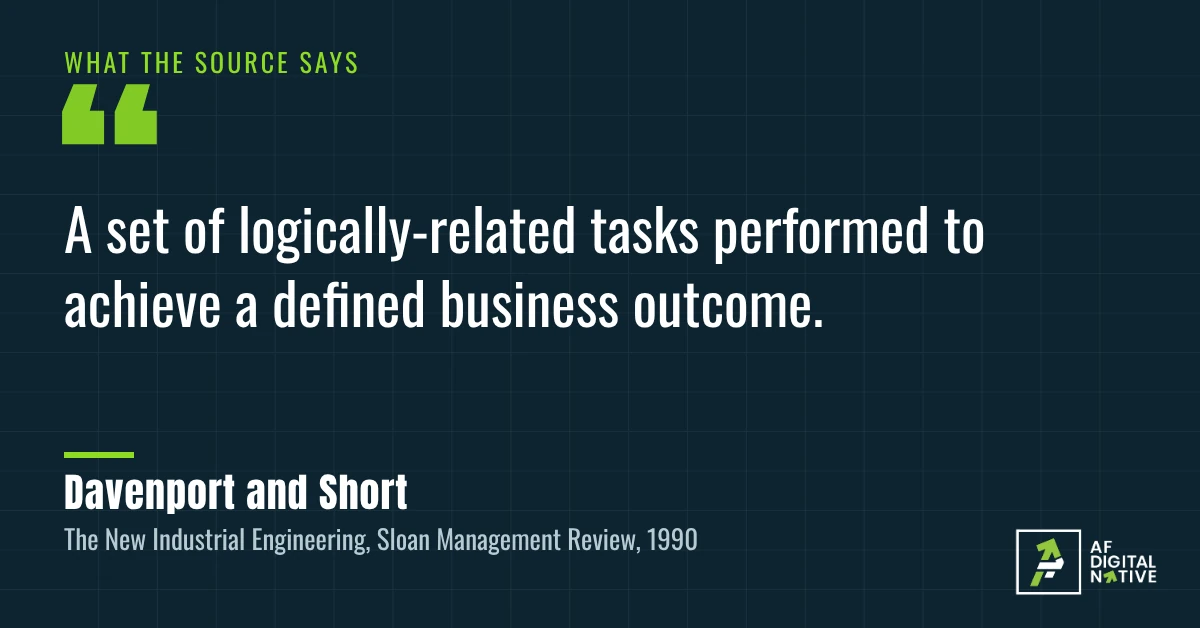
Now the word people mix this up with: process. In 1990, Thomas Davenport and James Short defined a business process in the Sloan Management Review as "a set of logically-related tasks performed to achieve a defined business outcome."
I keep the two words apart. The process is the what: the outcome you want, and the tasks that lead to it. The workflow is the how, in motion: who does what, in what order, and where the work changes hands. The difference shows you where to look.
02Five kinds of workflow
Not every workflow moves the same way. Wrike, a company that sells work-management software, names five kinds in its guide: sequential, parallel, state machine, rule-based and ad hoc. It also notes that most teams use several at once. I like the list because it describes how work really moves, and it helps you decide how much to write down. The examples below are mine.
| Kind | How the work moves | Example | Watch for |
|---|---|---|---|
| Sequential | One step after another. Each needs the last one’s result. | A contract goes to legal, then finance, then an executive. | One stall stops everything behind it. |
| Parallel | Several steps at the same time, then they join. | For a new hire, IT sets up accounts while HR does paperwork and the manager plans week one. | The join: someone has to know when all the pieces are done. |
| State-based (Wrike calls it state machine) | Work sits in a status and moves when something changes. | A support ticket goes from new to waiting on the customer to escalated to resolved. | A status nobody updates. |
| Rule-based | A condition picks the path. | A discount past a set limit needs a second approval. An AI step labels a ticket, and a rule routes it by label. | Rules that pile up until nobody can explain them. |
| Ad hoc | No fixed order. Each case is handled as it comes. | A one-off request from a customer or an executive. | The same "one-off" showing up every week. |
Most real jobs mix them. Take a deal that closes. The approval is sequential. The setup runs in parallel. The account moves through statuses. A rule sends large deals to extra review. And somewhere in the middle, a customer asks for something nobody planned for, and that part is ad hoc.
Look at the last row. Ad hoc work is the one place where writing a workflow is often not worth it. But watch for the one that keeps coming back. An "ad hoc" task that appears every Friday is a workflow nobody has admitted to yet.
03What a workflow is not, and the myths that mislead
Words get stretched. When a word is stretched, people buy the wrong thing. Five things get mistaken for a workflow.
| It gets mistaken for | What it actually is | A quick test |
|---|---|---|
| A flowchart | A flowchart is a drawing of a workflow. The workflow is the work running. | Can I point to this happening today, or only to a diagram? |
| A tool or software | A workflow can run on paper, in email, or in a tool. The tool holds it. | Would it still exist if we cancelled the subscription? |
| A process | The process is the outcome and its tasks. The workflow adds who does what, in what order. | Am I describing what we achieve, or how the work moves? |
| A checklist | A checklist keeps one person from skipping a step. A workflow carries work between people. | Does the work change hands? |
| An automation or an AI agent | Automation runs a step by itself. An agent chooses its own steps. Both live inside a workflow. | For this step, who or what does it: a person, a script, or an AI? |
I want to dwell on the checklist, because the ICU story is a checklist story. The checklist mattered. But the program also had a cart, training, and a way to stop work when a step was missed. A checklist on its own, in a unit where work changed hands with no clear owner, would have been a piece of paper. The checklist was one part of the workflow, and I would not credit it with the whole result.
On the last row, an AI agent chooses its own steps, which is exactly why it needs a workflow around it: a start, someone who checks it, and a finish line. AI agents explained goes deeper.
Then there are the myths. These are the ones I hear most.
"We don’t have workflows." You do. A deal closes and something happens next. If the steps live in people’s heads, the workflow is unwritten, not absent. That is what the refund test in the introduction shows.
"Only big companies need them." Size is not the test. Handoffs are. A five-person team with one handoff that keeps dropping has the same problem as a large company. The large company just has more handoffs, across more departments, with more people between the request and the result.
"Writing it down makes everything rigid." I think it is the other way around. Work gets rigid when nobody planned for the exceptions. A good workflow says what to do when something does not fit, and who decides.
"Build it once and it’s done." Workflows drift. Roles change, a vendor updates a tool, someone adds a side step. A workflow that was right last year may be quietly wrong now. Keeping one honest is its own job, and the Maintain articles in this series cover it.
04What a workflow gets you, and what it costs
Once they are visible, you get six things.
What you get:
- The same result with or without one person. The steps and the owners are written down, so a vacation does not stop the job.
- Fewer dropped handoffs. Each handoff has a named receiver and a visible status.
- A faster start for new people. They can find the steps, instead of finding the one colleague who knows.
- Waits you can see. When you can see where work sits, you can fix where it sits.
- Something to automate. You cannot automate what you cannot describe. The same goes for handing a step to an AI.
- A record. Approvals leave a trail, which matters in larger organizations that have to answer for a decision later.
What it costs:
- Time. Someone has to write it down and test it on a real case.
- Upkeep. Workflows drift, as the last chapter said.
- Adoption. If people route around it, you have paperwork. Wrike lists low adoption as a common challenge, and my experience matches.
- Overbuilding. A heavy workflow for a job that runs twice a year costs more than it saves.
A word about tools. I build workflows inside tools, and I believe the best home for one is a tool where the steps, owners, approvals and status are tracked and visible. A shared document or a page on a wall is a fine place to start. A tool can hold a workflow, but it cannot decide one, and A tool is not a system goes through why. This article is about whether to do it, not where. The next article covers the how.
05Is it worth doing for your business?
Now the part you came for. Pick one job you have in mind and answer these six questions about it.
Count your ticks. This is how I read the total, and it is my rule of thumb, not a studied formula.
| Ticks | What I would do | Example |
|---|---|---|
| 4 to 6 | Write a workflow. | A contract that crosses legal, finance and sales, with approvals and a cost for mistakes. |
| 2 to 3 | A checklist may be enough. Start there. | A monthly close done by one finance person, or a quarterly review of a website. |
| 0 to 1 | Leave it alone for now. | A one-time vendor migration, or a brainstorm. |
Then add the benefit side with three questions.
- How often does it run? A job that runs daily repays the effort fast. A job that runs twice a year may not.
- What does today’s way cost? Count the hours, the rework, the risk and the customers who waited.
- How stable is it? If the job changes every week, write down what you know as notes and wait. A workflow for a moving target is out of date before it is finished.
Some jobs should not get a workflow, and I would rather say so than sell you one.
- A one-time job. There is nothing to repeat.
- Creative or exploratory work. The value is in not following a fixed path.
- A rare job. A short checklist will do.
- A job still taking shape. Let it settle first.
If you have several jobs that score high, Find the one job worth turning into a system helps you pick which to start with. To see how a job really runs today before you write anything, try Map one process before you buy anything.
Where this advice can mislead
- I build these for a living. I believe in managing a workflow in a tool, and that shapes what I notice. Weigh my view with that in mind. I also offer a Systems Assessment.
- The definitions are not neutral. Wrike sells work-management software, so its benefits lean toward managing work in a tool. Its guide says nothing about when you do not need a workflow, so that part is my own view. Writers use "workflow" in different ways. I use it broadly, for any order of steps carried out by people, software or both.
- The ICU story is one program. It was in hospitals, it included several changes at once, and it tracked the same units before and after. That shows a large drop alongside the whole program. I cannot say how much each part mattered.
- The six-question count is my rule of thumb. It is meant to start a conversation, not to settle one.
- A workflow nobody follows is only paperwork. All the benefits above depend on people using it.
Your five questions
If you cannot answer the last one, the workflow exists only in people’s heads.